

Adult Children of
Emotionally Immature Parents
If you grew up feeling expected to meet your parent’s emotional needs, rather than the other way around, you may be carrying the effects of being raised by an emotionally immature parent.
Maybe your parent reacted to your pain with annoyance, drama or withdrawal, or turned every situation back to themselves. You may have walked on eggshells and learned to read others’ emotions without tuning into your own. You’ve carried these experiences with you into how you see yourself, what you expect from relationships and whether you feel safe expressing your own thoughts, feelings and needs.
Many of the women I work with are still navigating these family dynamics as adults. They love their parents, yet feel emotionally exhausted by the relationship. They worry about disappointing them, feel responsible for keeping the peace, and often put their lives on hold or risk upsetting them. Over time, resentment builds, followed by guilt for feeling that way. Somewhere in the middle of caring for everyone else, they lose touch with themselves.
You can love your parent deeply and still become fully yourself.
I’mDr. Holly Spotts, and I help women understand where these patterns came from, let go of the old family rules they’ve lived by for so long, and build lives guided by their own values instead of everyone else’s expectations.
What Are the Signs of an Emotionally Immature Parent?.
Emotionally immature parents can look very different from one another. They can even be the favorite parent. Some are highly successful, loud and unpredictable. Others are quiet, passive and loving. What they often struggle with is responding to their child’s emotional needs with consistency and curiosity. The relationship becomes organized around their emotions, needs and perspective.

You may recognize some of these patterns:
Limited empathy…
They have difficulty truly understanding or validating your emotional experience.
Everything becomes personal…
They often react defensively to feedback, struggle to tolerate disagreement, and have difficulty reflecting on their own behavior. Instead, they blame others or rewrite events to protect their self-image.
Resistance to emotional intimacy…
Closeness feels threatening; they withdraw when you need connection most.
Role Reversal…
Instead of providing emotional support, they look to you for validation, reassurance or comfort. As the child, you became the emotionally mature one in the relationship.
Emotional reactivity…
Their moods shift without warning; small triggers produce large reactions.
Difficulty with limits…
Your independence feels like rejection. They intrude upon your space, share what you asked them to keep private, or use guilt, criticism or withdrawal to pull you back in.
Little curiosity about who you really are…
They expect you to play a specific role in their lives, rather than encouraging your individuality.
The Four Types of Emotionally Immature Parents
Emotional immaturity is not a diagnosis. Understanding your parents isn’t about blaming them either. It’s about finally making sense of experiences that may have left you questioning yourself and may still be affecting you today. In Adult Children of Emotionally Immature Parents, Dr. Lindsay Gibson describes four common styles:
Emotional Parents
Emotional parents are often unpredictable. Their feelings tend to fill the room, and those around them learn to adjust accordingly. As a child, you may have felt overwhelmed by them or responsible for calming them down, preventing their reactions or meeting their emotional needs that were never yours to carry.
Driven Parents
Driven parents often appear highly responsible and successful. They value achievement, productivity, and doing things the “right” way. While they may provide well for their kids, emotional connection takes a back seat to performance, expectations and appearances. You may have grown up believing your worth depended on what you accomplished rather than who you were.
Passive Parents
Passive parents often avoid conflict and therefore may struggle to protect their child or stand up to a more dominant partner. They may seem kind and easygoing, but their inability to step in can leave a child feeling unseen, unsupported, or alone during the moments they needed someone most.
Rejecting Parents
Rejecting parents create emotional distance when closeness is needed most. Some are openly critical or dismissive. Others simply seem unavailable, uncomfortable with connection or irritated by a child’s needs. Over time, kids learn that relying on others isn’t safe and begin handling life’s challenges alone.
Many parents carry traits from more than one type, and the same parent may shift between patterns depending on their circumstances. What matters is less the category and more the experience you had as the child in the relationship.
What Emotionally Immature Parenting
Looks Like in Real Life
The following examples are composites based on common experiences I see in therapy and are designed to illustrate patterns rather than any one person’s story. Emotional immaturity isn’t always obvious. It often hides inside everyday conversations that leave you feeling guilty, confused, responsible or like you’ve done something wrong when you haven’t.
 Kelley* is 23 years old. Her mother is 55.
Kelley: What are you doing here, Mom?
Mom: I wanted to surprise you! I used my key and let myself in. I did your laundry. How often do you clean the bathroom?
Kelley: Bill and I live together now, Mom. You can’t just pop in and do my laundry. This is his home, too.
Mom: Is he controlling you? He’s going to isolate you from your family!
Kelley: No, he is not controlling me. I’m not a kid anymore!
Mom (crying): You’re still a child because you’re not grateful for all I do for you.
Kelley: I’m sorry, Mom.
 Lisa* is 57 years old. Her mom is 79.
Mom: My blood pressure is too high. I need you to take me to the Emergency Room.
Lisa: Mom, I’m visiting with a friend tonight. It’s the first night I haven’t visited in weeks.
Mom: How can you say that when this is an emergency?
Lisa: Why don’t you take your blood pressure reading and tell me what it says?
Mom: Your friend is obviously more important to you than I am.
Lisa: That’s not it, mom. I need to have a social life.
Mom: You’ll regret it if I die! [Click!]
 Melissa* is 31 years old. Her mom is 53.
Mom: I bought us all tickets to see a show on Joshua’s birthday!
Melissa: Mom, his birthday is a school night. We were planning a family dinner. I wish you’d discussed this first.
Mom: He can miss one day of school. He’s only seven!
Melissa: I don’t know…
Mom: I spent a lot of money and I promised Joshua. I can’t wait to see his face when he finds out Grandma got the tickets!
 Lindsey* is 30 years old. Her dad is 60.
Dad: I’m done with you!
Lindsey: What? Why?
Dad: I sent you an email a week ago saying I wanted to stay with you and you never responded.
Lindsey: Dad, I’ve been on vacation and haven’t had a chance to respond to emails.
Dad: I’m sick of not being appreciated. I gave you the best life growing up.
Lindsey: Yes, you did, but that has nothing to do with this.
Dad: You don’t appreciate me. I’ll visit your sister instead. She appreciates me!
Kelley, Lisa, Melissa, and Lindsey have a lot in common. They were all raised by emotionally immature parents. They’re all feeling frustrated, disrespected, and unsure about how to handle these situations. Even though they’re adults now, they often feel like they’re still “in trouble” with their parents and can’t seem to please them.
Over time, many adult children become so focused on managing everyone else’s emotions that they lose touch with their own. Caring for themselves begins to feel unfamiliar, and even thinking about putting themselves first can bring on overwhelming guilt.
*The names and photos above are illustrative composites and do not reflect actual clients.
How Growing Up With an Emotionally Immature Parent
Affects You as an Adult.

You left home years ago, but the patterns are still showing up in your relationships, your boundaries, your confidence, and the way you relate to yourself.
Many of the women I work with see themselves in several of the patterns below. Together, we’ll understand where they came from and begin building new patterns that reflect your values instead of your survival strategies.
Disconnecting From Yourself
Feeling guilty for having needs
Taking care of yourself can feel selfish because keeping the peace always came first.
Disconnecting from yourself
You learned to pay attention to everyone else’s emotions before your own, making it hard to know what you truly feel, want or need.
A deep sense of loneliness
You may feel lonely, even when you’re surrounded by people because you’ve never felt truly known.
Revolving Around Everyone Else
Hypervigilance
Your nervous system is always scanning the room, anticipating other people’s moods and reactions to stay safe.
People-pleasing
Saying yes when you want to say no, avoiding conflict, and over-explaining became ways to stay connected to others.
Why Change Feels So Hard
Guilt around boundaries
Even setting healthy boundaries can leave you feeling anxious, guilty, or like you’ve done something wrong.
Self-doubt
When your reality was repeatedly dismissed, trusting yourself stopped feeling safe.
None of these patterns mean something is wrong with you. They developed because they helped you adapt to an environment that asked more of you than a child should have had to carry.
None of these patterns are permanent. Together, we’ll understand where they came from and begin building new patterns that allow you to feel more grounded, connected and fully yourself.
 What Healing Actually Looks Like.
Understand…
Healing isn’t about blaming your parents or cutting them out of your life. It’s about understanding how your experiences shaped you so it no longer controls you.
Decrease Reactivity & Set Healthy Boundaries…
Learn to express your needs and boundaries in a way that you’re proud of and tolerate the discomfort
Heal From Emotional Loneliness & Let Go of Healing Fantasies…
Therapy provides a corrective emotional experience where you’ll finally feel seen, heard, and validated. You’ll learn about radical acceptance and freeing yourself from the fantasy of having a nurturing parent.
Reparent Yourself…
The critical inner voice many adult children carry is often the voice of a parent, internalized. Therapy can help you distinguish that voice from your own, and practice relating to yourself with the care and compassion you deserve. Adults who do this work describe feeling less reactive, more grounded in their own identity, and more capable of the kinds of relationships they’ve always wanted.
Working With a Therapist Who Understands This
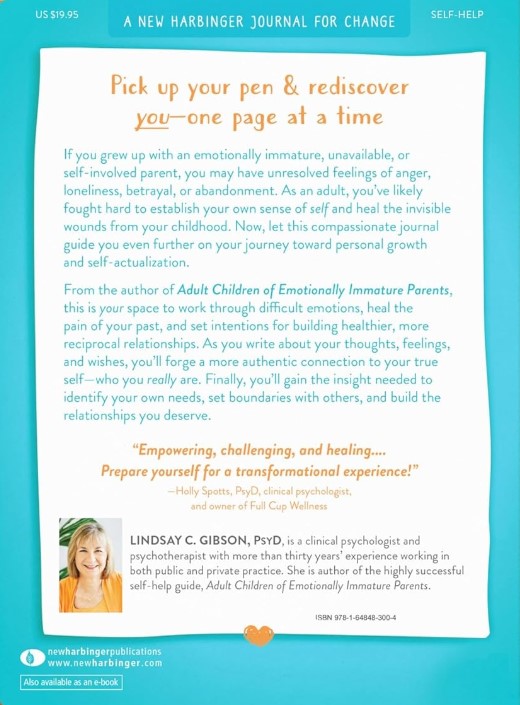

This work has become one of my deepest professional passions. I’ve had the privilege of training directly with Dr. Lindsay Gibson, whose groundbreaking work has transformed the way we understand the lifelong effects of emotionally immature parenting.
I felt incredibly honored when Dr. Gibson asked me to read and endorse one of her books, Adult Children of Emotionally Immature Parents Guided Journal. To my surprise, she selected my endorsement to appear on the back cover.
While specialized training matters, what matters most is that you feel understood, supported and safe enough to begin trying something different. Together, we’ll help you reconnect with your authentic self and create relationships that feel more genuine and fulfilling
Imagine what life could feel like when your needs matter, too. It’s time to reconnect with yourself.
Give me a call at (916) 705-2896 for a free 20-minute
consultation.
Frequently Asked Questions About
Adult Children of Emotionally Immature Parents
Can you heal from the effects of emotionally immature parenting?
Yes. Childhood experiences shape us, but they don’t have to define the rest of our lives. Healing is about understanding yourself with compassion, developing healthier patterns, and meeting your own needs. Many adults describe this process of developing a secure relationship with themselves as life changing.
Do I have to cut off my parents to heal?
No. Therapy isn’t about telling you whether to stay or leave a relationship. It’s about helping you understand yourself and make decisions from a place of clarity rather than guilt. Some people choose distance. Others create healthier relationships without cutting contact.
How do emotionally immature parents affect adult children?
Many struggle with anxiety, guilt, people pleasing, emotional loneliness, difficulty trusting themselves and feeling chronically responsible for others’ happiness. They often develop adaptive patterns that helped them survive childhood but now make adult relationships exhausting until they’re understood and healed.
What are the 4 types of emotionally immature parents?
Dr. Lindsay Gibson describes four common patterns: emotional, driven, passive and rejecting parents. Many parents show characteristics of more than one type. What matters most isn’t the label, but how those patterns of parenting affected your emotional development and relationships.
When should I see a therapist?
If your relationships leave you feeling guilty, emotionally drained, unseen, or responsible for everyone else, therapy can be transformational. Many of the women I work with have spent years believing something is wrong with them, only to discover they were responding adaptively to an emotionally immature environment.
Is online therapy effective?
Yes. Research consistently shows that online evidence-based therapy approaches can be just as effective as in-person therapy. It also makes accessing specialized care more accessible if you don’t have a therapist in your area who specializes in the effects of emotionally immature parenting.
Why do I feel guilty setting boundaries with my parent?
Because healthy boundaries often break old family rules. For example, imagine your parent asks you to help her with some gardening this weekend but you already have plans. She replies, “I guess I’ll just do it myself. Why am I the only one whose daughter doesn’t help her?” Suddenly, you feel guilty and wonder if you’re being selfish. The guilt is coming from breaking an old family rule, such as “A good daughter always puts her mother first.” In therapy, we’ll identify those old family rules as well as a new set of rules based on your own values so you can set healthy boundaries without abandoning yourself.

About Full Cup Wellness
Full Cup Wellness provides therapy for women in California, Florida, and Mississippi, with in-person appointments available in Roseville, California.
I’m Dr. Holly Spotts, a clinical psychologist with more than 20 years of experience helping women reconnect with themselves after years of putting everyone else first.
Many of the women I work with are Adult Children of Emotionally Immature Parents. Others are navigating difficult partner relationships, perfectionism or anxiety. No matter what brings you here, my goal is the same: to help you understand yourself with compassion, build healthier relationships, and create a life that feels fully yours.
Full Cup Wellness does not provide crisis services. If you are experiencing a mental health emergency or are in immediate danger, please call or text 988 (Suicide and Crisis Lifeline) or go to your nearest emergency room.